Long-Term Economic Viability and Farm Succession
Economic viability of the farm business is one of the many challenges facing successful farm succession. A less-than-ideal economic situation may sustain for several years under the current generation whose economic needs and desired lifestyle are largely met. However, that same economic situation may not work for the next generation who is looking to build wealth for their future and their children. At this point, economic viability has increasing importance.
This chapter is organized into three parts:
- Concept, definition, and measurable goals for long-term economic viability
- Process for evaluating current viability and determining future strategic direction
- Analytical methods for deeper evaluation of viability components for focusing management decisions and actions
In addition, the Appendix provides links to several analysis tools.
Part 1: Long-Term Economic Viability – Concept, Definition, and Measurable Goals
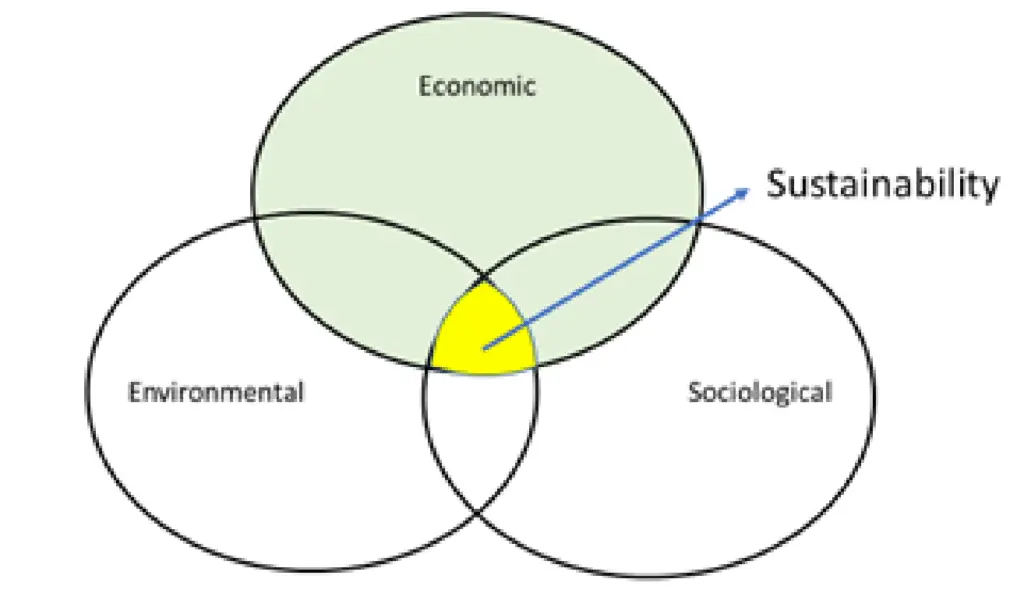
Economic viability is rooted in the broader ideal of sustainability. While the definition of sustainability continues to evolve, Figure 1 illustrates the broad agreement that sustainability includes some interconnected mix of economic, environmental, and sociological goals (Latruffe et al., 2016).
Economic viability itself is more narrowly defined as farm-level financial success (Christensen & Limbach, 2019; Smale, Saupe, & Salant, 1986). Spicka et al. (2019) and O’Donoghue et al. (2016) provide summary definitions of farm-level viability from several authors and contrast U.S., Canadian, and European views. Common among the definitions is the capacity of the farm family to have enough financial success to “make a living,” while differences include how financial success I measured, the breadth of what is included in “making a living,” and the scope of measurement (farm, household, regional food system, etc.).
Scope is particularly important when considering the viability of the farm household versus the narrower scope of the farm business only. While a farm business itself may not be viable, the farm household may be sustainable due to off-farm income of household members (Hennessy, Shrestha, & Farrell, 2008).
The Working Definition
However, while the current generation may be viable due to non-farm sources of income, that viability may not transfer to the next generation. Thus, this discussion is confined to the financial viability of the farm business only to support family living and continuation of the farm, particularly in the context of transition to the next generation.
Latruffe et al. (2016) add risk and time to the definition of long-term economic viability for farm succession. Their definition includes the need for financial success to make a living, but they add the need to do so continuously in the long term (time) under changing economic conditions (risk) for the “professional life of the farmer, or across generations” (p. 125).
Building upon this previous work, following is both a working definition of long-term economic viability and financial goals for measuring viability in the context of transition. Long-term economic viability is the continuous capacity of the farm business to meet financial goals for the present generation under changing economic conditions, without compromising the financial ability of future generations.
The Five Financial Goals
Financial goals are the long-term ability of farm revenues to cover:
- Operating costs, interest, and taxes.
- Return to owner labor equivalent to its opportunity cost.
- Return to management equivalent to its opportunity cost.
- Asset recapitalization of the farm business.
- Return to equity capital equivalent to its opportunity cost
Changing economic conditions are the risks that farms face (prices, weather, policy changes, geopolitical events, human resources, the five Ds¹ , etc.). A farm business does not know what the risks will be, when they will occur, or future risks that are yet unknown. Thus, long-term economic viability must include robust resiliency to absorb the economic consequences of any risks that may occur now and in the future.
Understanding Opportunity Costs
Opportunity cost refers to broader choices an individual has about where they can employ their labor, management, and capital. The earnings forfeited by owners for putting their labor, management, and capital into farming instead of some alternative is real money not in their pocket because of their choice to stay in farming. This forfeited money is an opportunity cost and for the next generation who is already at a point of choice, covering this cost may be a deciding factor for returning to the farm.
Opportunity cost of owner labor refers to the manual labor supplied by owners, while opportunity cost of management is the owner’s thinking, planning, organizing, coordinating, decision-making, directing, etc. The value of each depends on the owner’s alternative employment opportunities for their labor and management. In practice, it can be estimated using local, state, or national statistics of labor salaries, 4 to 5 percent of total revenues, or some other method. Whatever method is used, the key is assessing whether the farm is providing a fair return for the owner’s physical and intellectual efforts compared to what they could command off the farm. Again, it may for the successor generation it is likely a major part of their decision-making.
Note, opportunity costs of owner labor and management are often estimated together as one sum. However, in this analysis, they are separated to distinguish a full versus partial return for the owner’s efforts.
Opportunity cost of owner equity is what the owner’s investment in the farm could return in a non-farm investment of similar risk. A conservative long-term estimate is 5 percent of owner equity. However, ultimately it is what return the owner would receive if they invested elsewhere.
Asset recapitalization is how much is needed each year to maintain and modernize the physical infrastructure of the farm (machinery, buildings, etc.). Each farm’s needs are unique depending on the type of business, degree of technology, age of current infrastructure, etc. A typical estimate based on the useful life of common assets is 10 percent of machinery market value plus 5 percent of buildings market value.
Part 2: Process for Evaluating Current Viability and Determining Future Strategic Direction
Table 1 shows a process for using the accrual income statement to evaluate viability strength or vulnerability through an analysis of how well gross farm revenues cover the five financial goals defined in the definition of long-term economic viability. Table 1 also shows a descriptive label for each level of viability, called the viability camp. The camps are Builder, Long-Hauler, and Guardian-Transitioner (Bernhardt, 2021).
Note, if an accrual income statement is not available or complete, then Worksheet 1 in the Appendix enables a limited analysis of viability based on answers to broad questions. The Appendix also has links to spreadsheet tools for creating financial statements, including the accrual income statement.
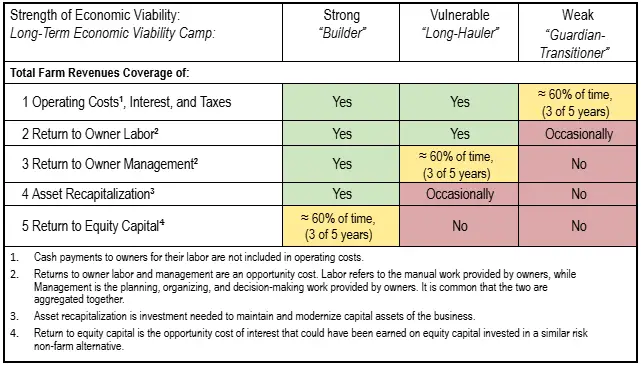
¹ Cash payments to owners for their labor are not included in operating costs.
² Returns to owner labor and management are an opportunity cost.
³ Asset recapitalization is investment needed to maintain and modernize capital assets.
⁴ Return to equity capital is the opportunity cost of interest earned on non-farm alternatives.
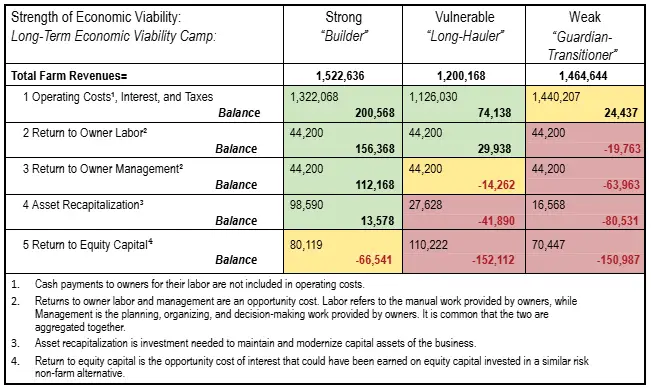
Table 2 shows an example using a 5-year average of three dairy farms of relatively the same size. For this example, the total of owner labor and management is valued at $88,400 split half into labor and half into management.² Knowledge of where you are is a big step toward proactively planning where you want to be. Each viability camp has future opportunities and/or limitations based on the business’s current financial health.
Figure 2 shows potential strategic directions for improving future viability based on which camp one starts from.
Analysis of Table 2 Farms

The “Builder” farm met most of the goals of long-term economic viability, coming up short of covering all needs for return to equity capital. If this 5-year average improves enough to cover equity capital as well, then they or their successors have a strong economic foundation and, as Figure 2 illustrates, are well positioned for a focus on growth, which may be growth in size, scope, efficiency, or investment in diversification on or off the farm. The successor generation has the benefit of knowing their labor, management, and equity is competitive with other alternatives, which can increase confidence and ability to successfully transition.
The “Long-Hauler” farm covered operating expenses, return to labor, and at least some return to management. This keeps them in business and provides some minimal family living. Depending on the situation, this may be enough (such as an older couple working toward nearby retirement). However, the Long-Hauler struggles to earn a full return to management, maintain or modernize the assets of the business as they wear out or become obsolete, and are seldom able to maintain a return to their equity capital.
The Long-Hauler is surviving, but the infrastructure and financial potential of the operation is deteriorating. Financial stress will never be very far away, and the Long-Hauler’s focus might be “riding it out.” Transition will likely saddle the next generation with infrastructure and/or a business model that are not economically sustainable. Thus, they begin their tenure knowing they are sacrificing the value of their labor, management, and equity capital. That is a tough ask of someone at the beginning of their career. Strategic options include a significant redesign of the business model and/or investment in the size, scope, and/or efficiency of the operation to one that has potential for improved economic viability.
Recall that this discussion is explicitly focused on the viability of the farm business itself and does not consider the broader viability of the farm household including consideration of off-farm income. There are likely many “Long-Hauler” farm situations where the owners have off-farm income and may even be using the off-farm income to subsidize the farm business. Taken as a whole, the household is economically viable and often quite successful. However, will the off-farm income transfer to the next generation? Thus, while the farm household may be economically viable for the current generation, that viability may not be transferable to the next.
The “Guardian-Transitioner” camp has significant financial vulnerabilities. Farm income just covers Goal 1 (operating costs, interest, and taxes), but falls short of all other goals. The Guardian-Transitioner must subsidize asset recapitalization and even family living from current equity³ or outside contribution. If infrastructure, the business model, and/or management is not working, the business is very likely to continue being financially stressed, and the erosion of equity will likely continue.
The focus for this camp is guarding remaining owner equity from further erosion by exiting the industry or partially exiting and restructuring to a new business model. This is the worst-case scenario for farm succession. Succession will take a major strategic realignment of the business model likely involving a partial exit or major investment from outside current resources.
A final note is that any single year can look financially dismal even for the best of farm operations. Thus, it is important that the financial measures of viability be a multi-year analysis.
Part 3: Processes for Deeper Analysis of Viability Components for Focusing Management Decisions and Actions
Evaluating the goals of economic viability gives a picture in time of the operation’s current viability status. While that is important baseline information, many owners/managers are interested in how viability got to where it is today, what is holding it back, and which components of the operation to focus on to build greater viability in the future.
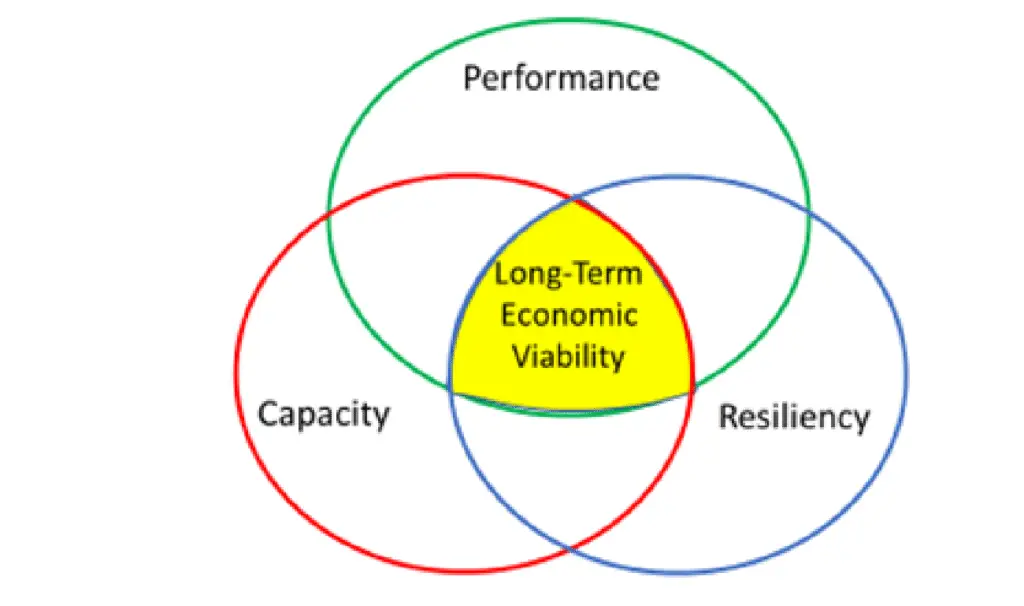
Figure 3 shows a three-part process for analyzing the components of long-term economic viability, which are:
- Performance
- Capacity
- Resiliency
Performance
Performance is a financial analysis of balance sheets and accrual income statements. The farm business will have unprofitable years, potentially for reasons beyond the owner’s control; however, the question is whether there is long-term average performance consistent with industry standards and top performers and what areas of the operation need improvement.
There are many tools and methods for evaluating financial performance (see the Appendix). One benchmark that is widely used is the Farm Financial Scorecard⁴ that organizes ratios into areas of financial performance that can be compared to industry standards including liquidity, solvency, profitability, repayment capacity, and financial efficiency. Ratios used are vetted and approved by the Farm Financial Standards Council, which also publishes its recommendations in the Financial Guidelines for Agriculture (2023).
While liquidity, solvency, etc., are important measures, greater profitability ultimately is the foundation for long-term viability. The DuPont system for financial analysis is a process that can be used to analyze three primary levers of profitability and determine where to target management for greater profitability. The three levers are:
- Creating gross revenues from assets
- Efficient use of inputs
- Leverage
See the Appendix for links to more information and tools on the DuPont system.
Capacity
Capacity is a size question. Are there enough cows, acres, or trees to meet the five goals of long-term economic viability? Capacity is centered in the profit equation:
Total Profits = (Price*Quantity) - Costs of Production
Many farms produce and sell commodities. The commodity-based business model is characterized by being price takers, that is, having little to no control over market prices.⁵ The value-added business model has more control over prices but is still constrained by competition. Thus, the farm owner/manager is limited in how much impact they can have on profits from market prices.
While many farms, especially commodity-based farms, are price takers, they are not cost takers. Management can have an impact on costs of production, which is part of the performance analysis previously discussed.
This leaves quantity. Quantity comes from two sources. One is the efficient use of resources to get more from each unit of production (milk per cow, bushels per acre, apples per tree, etc.) and the other is having enough production units (cows, acres, trees, etc.). Having enough production units is capacity.
An operation can be very efficient in making profit margins per cow, acre, or tree. However, if there are not enough cows, acres, or trees to earn that profit margin on, then the total profits generated may not be enough. Further, while capacity may be sufficient today, is it sufficient to accommodate a successor generation? Finally, the “right” amount of capacity depends on the business model. A commodity-based business will have a different “right” capacity than a value-added model; nevertheless, while its meaning may change, capacity is a component of viability for any business model.
One way to evaluate capacity is “what-if” analysis. The “Capacity and Breakeven Evaluation” spreadsheet tool (see the Appendix) provides a means to evaluate capacity questions based on expected prices, costs of production, and profit goals.
Resiliency
The third component, resiliency, is the comprehensive implementation of risk management strategies and management practices that enable a business to absorb the shocks from changing economic and other conditions that may occur over the long term. Changing economic conditions include weather, prices, geopolitical events, climate change, death, exit of a managing partner, new technology, new laws, and many more (some of which will occur in the future that we are not even aware of today). Building resiliency includes legally binding products such as insurance, marketing contracts, lines of credit, wills, trusts, etc. It also includes management practices such as contingency planning, safety training, personal relations, third-party assessments, and labor management.
Resiliency is often the Cinderella of management, often forgotten, in the background, and almost irrelevant until the big risk event occurs. Resiliency is also typically a cost and since the general management challenge with costs is reducing or eliminating them, the cost of resiliency is often on the cutting block. Making this more challenging is that the likelihood of a bad event occurring today, next week, next month, or even next year may be low. Yet, if long-term economic viability is the goal, especially a long-term one that spans multiple generations, then a business must be able to survive the challenges that will arise.
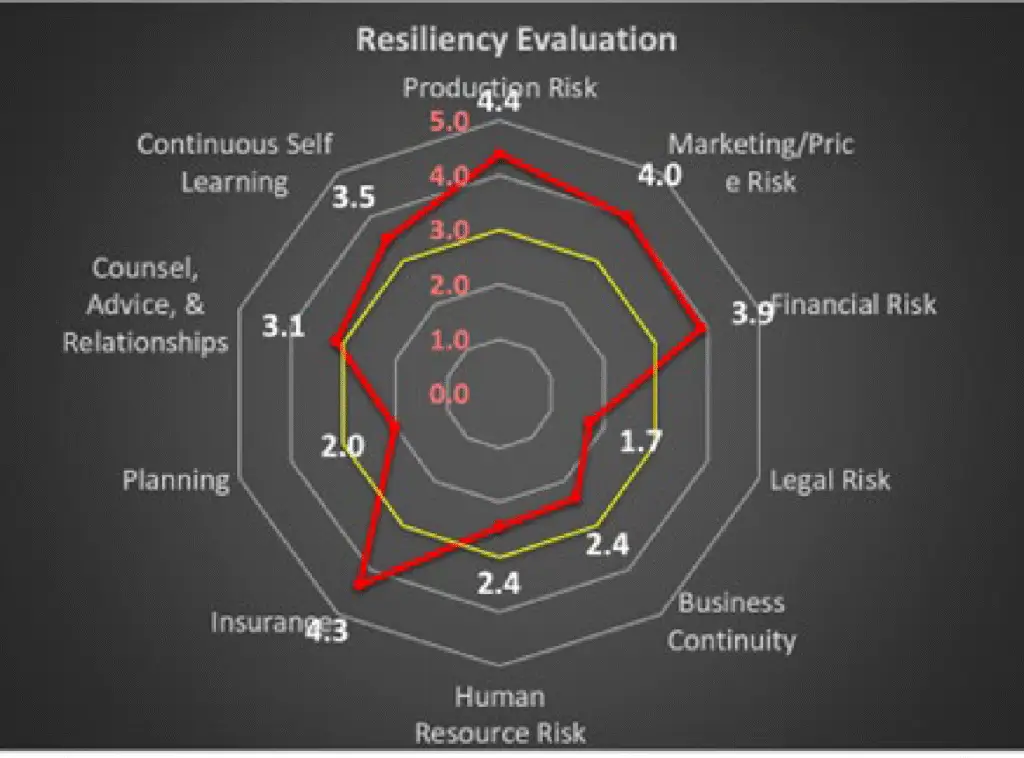
Figure 4 shows an illustration of the Resiliency Wheel, an easy-to-use awareness tool that can provide a resiliency map of strengths and weaknesses. Each spoke of the wheel is an area of potential risk. The red numbers in Figure 4 are a score of the degree of management in each area where a “5” means robust risk strategies or management practices are in place and a “1” means there are no strategies or practices in place and the business is vulnerable, potentially catastrophically vulnerable. Any areas less than 3.0 indicate an area of vulnerability and thus an area of potential management attention for increasing long-term economic viability.
The best wheel for getting through the mud (risk) of agriculture is large and round. Attention to all areas of risk gives a round wheel and significant attention to each risk (a score of 5) gives a large wheel. The red resiliency map shown in Figure 4 is far from round or large and one can quickly see areas needing management attention The Appendix has links to the Resiliency Wheel map and other resources for resiliency and risk management.
Summary
In this chapter, long-term economic viability was defined including five successive goals that if maintained for the long run under changing economic conditions, result in strong economic viability for the present and next generation. A process was also defined for estimating the current strength and viability camp—Builder, Long-Hauler, or Guardian-Transitioner. Depending on the viability of the camp, various general future strategic directions were identified. Finally, analysis processes were offered for how to dive deeper into the components of long-term economic viability— Performance, Capacity, and Resiliency. Results of deeper analysis gives owners/managers information on where economic viability is being held back, and where management time has the potential to improve viability in the future.
Appendix: Analysis Resources and Tools
Following are a few resources for creating financial statements, ratios, and other analytical tools.
Qualitative Assessment
- Worksheet 1: Limited analysis of viability based on answers to broad questions. Worksheet 1 at the end of the Appendix can be used for those interested in a quick qualitative assessment of economic viability, or for situations where financial statements are not available. It is a limited analysis but may at least be a conversation starter for thinking about economic viability.
Performance Tools
- Developing a Farm Financial Model: provides an explanation of the financial management flow of the farm business and includes three spreadsheets that enable the creation and analysis of financial statements. farms.extension.wisc.edu/articles/developinga-farm-financial-model
- Financial Statement and Analysis Spreadsheet Video Series: includes a series of videos that explain how to use the spreadsheets. farms.extension.wisc.edu/articles/financialstatement-and-analysis-spreadsheet-video-series
- DuPont: The “DuPont Analysis: Making farm financial benchmarking easier and more meaningful” website includes an explanation and video of how to use and analyze the DuPont model. farms.extension.wisc.edu/articles/dupontanalysis
- Online Courses: The Farm Pulse is an online financial statement construction and analysis course. go.wisc.edu/farmpulse
Capacity & Resiliency
- Capacity and Breakeven Evaluation spreadsheet: farms.extension.wisc.edu/articles/is-my-farmoperation-big-enough
- Resiliency: The “Risk and Building Better Resiliency” website includes an explanation and tools for evaluating risk and resiliency. farms.extension.wisc.edu/articles/risk-andbuilding-better-business-resiliency
References
Bernhardt, K. (2021, April 1). 3 measures of long-term farm viability. Progressive Dairy, Issue 6, pp. 21–23.
Christensen, L. & Limbach, L. (2019). Finding common ground: Defining agricultural viability and streamlining multi-organization data collection. Journal of Agriculture, Food Systems, and Community Development, 8(C), 137–152. https://doi.org/10.5304/jafscd.2019.08C.005
Hennessy, T., Shrestha, S., & Farrell, M. (2008). Quantifying the viability of farming in Ireland: Can decoupling address the regional imbalances? Irish Geography, 41, 29–47.
Latruffe, L., Diazabakana, A., Backstaller, C., Desjeux,Y., Finn, J., Edel, K., Ryan, M., & Uthes, S. (2016). Measurement of sustainability in agriculture: a review of indicators. Studies in Agricultural Economics, 118(3), 123–130. DOI: 10.7896/j.1624.
O’Donoghue, C., Devisme, S., Ryan, M., Conneely, R., Gillespie, P., & Vrolijk, H. (2016). Farm economic sustainability in the European Union: A pilot study. Studies in Agricultural Economics 118, 163¬–171.
Smale, M., Saupe, W.E., & Salant, P. (1986). Farm family characteristics and the viability of farm households in Wisconsin, Mississippi, and Tennessee. Agricultural Economics Research, 38(2), 11–27.
Spicka, J., Hlavsa, T., Soukupova, K., & Stolbova, M. (2019). Approaches to estimating the farm-level economic viability and sustainability in agriculture: A literature review. Agricultural Economics-Czech, 65(6), 289–297. DOI: 10.17221/269/2018-AGRICECON
Footnotes
¹ The five Ds are Death, Divorce, Disaster, Disability, and Disagreement.
² This estimate is based on the owner splitting time between manual labor and management at half-time each with manual labor being worth $25/hour (more skilled and experienced than the typical farm laborer) and $60/hour for management. Other methods could be used for valuing management such as 4 to 5 percent of total revenues.
³ Current equity can be used to subsidize other parts of the business by selling capital assets or borrowing against the equity and using the proceeds to cover expenses and family living.
⁴ The scorecard was developed by the Center for Farm Financial Management at the University of Minnesota and the University of Vermont Extension using ratios from the Farm Financial Standards Council’s Financial Guidelines for Agriculture (https://ffsc.org/).
⁵ Commodity marketing tools such as futures, options, forward contracts, etc., can be used to pre-price a product, but there is little that can be done to change the ultimate market price.
Worksheet 1: Determining Your Viability Camp Without an Income Statement
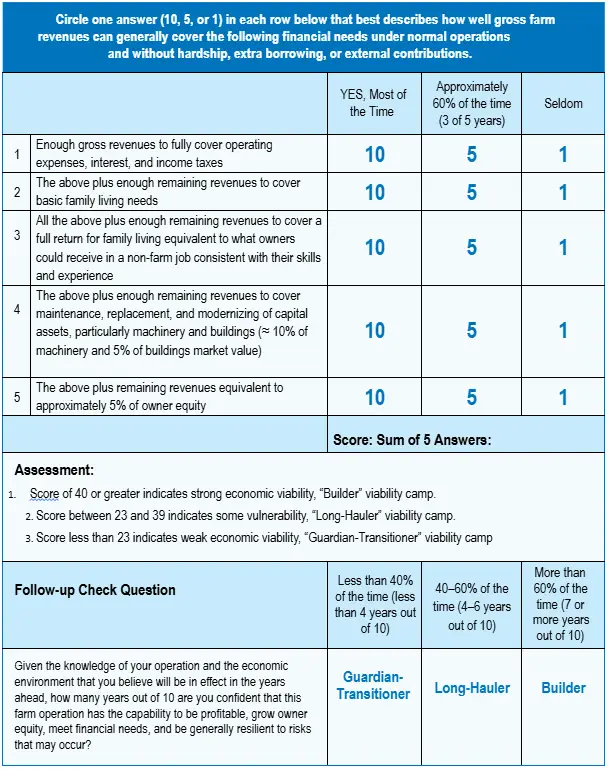
Score: Sum of 5 Answers: _________ Assessment:
- Score of 40 or greater indicates strong economic viability, “Builder” viability camp.
- Score between 23 and 39 indicates some vulnerability, “Long-Hauler” viability camp.
- Score less than 23 indicates weak economic viability, “Guardian-Transitioner” viability camp
Follow-up Check Question
Given the knowledge of your operation and the economic environment that you believe will be in effect in the years ahead, how many years out of 10 are you confident that this farm operation has the capability to be profitable, grow owner equity, meet financial needs, and be generally resilient to risks that may occur?
- Guardian-Transitioner: Less than 40% of the time (less than 4 years out of 10)
- Long-Hauler: 40–60% of the time (4–6 years out of 10)
- Builder: More than 60% of the time (7 or more years out of 10)
Author Bio
By Dr. Kevin Bernhardt, Farm Management Specialist at the University of Wisconsin–Madison Division of Extension and Professor of Agribusiness at the University of Wisconsin–Platteville School of Agriculture